It's Not the Price.
The 3 loose wires on every page that doesn't sell.
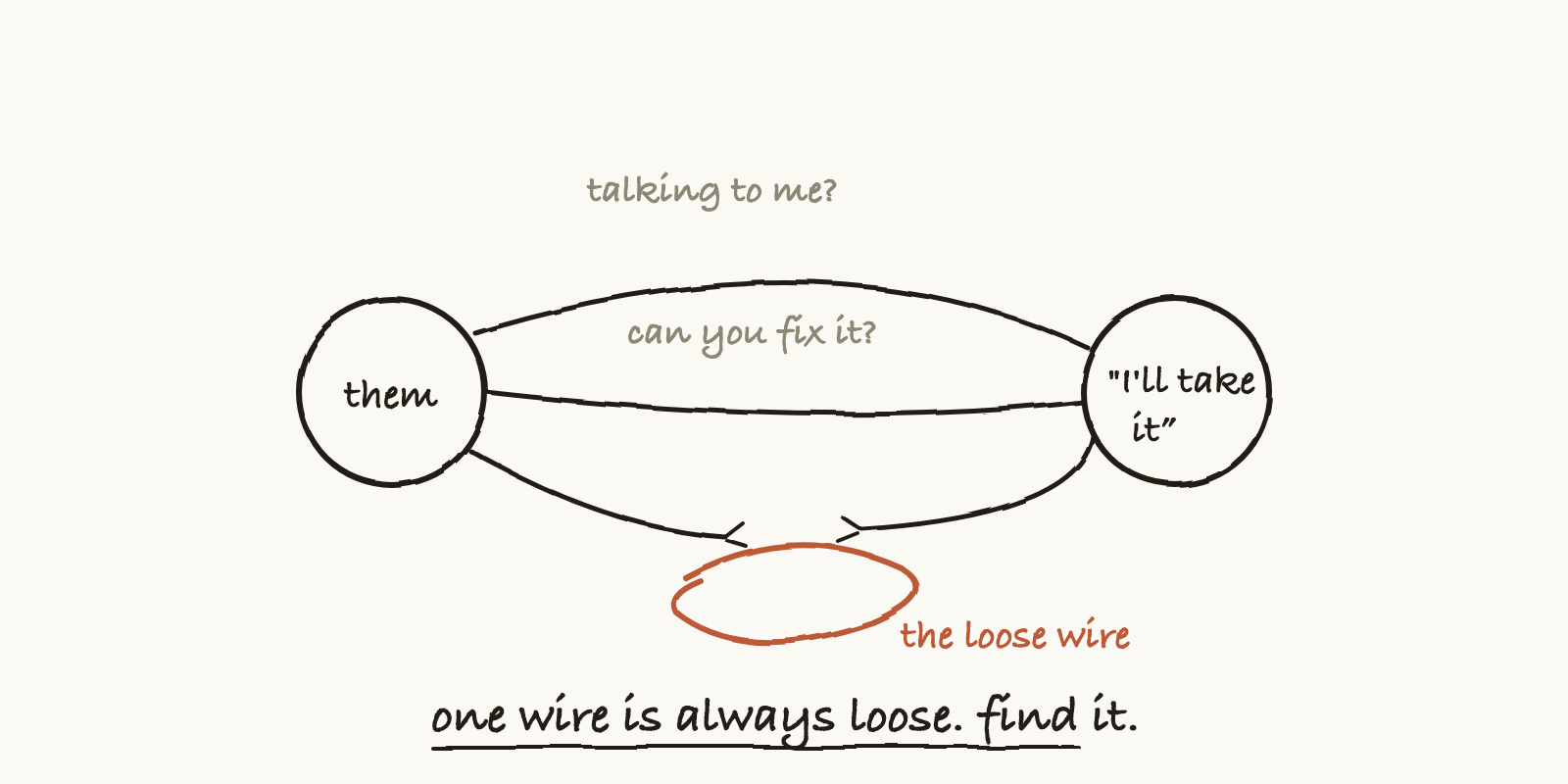
You have traffic. You have an offer. You don't have sales.
And when you sit down to explain why — to yourself, to a partner, to whoever will listen — the guesses are always the same. The price is too high. The algorithm buried me. People just aren't buying right now.
I understand the appeal of those explanations. They're painless. Every one of them lives outside of you, outside of your page, outside of anything you'd have to change.
But the reality is, when a person lands on your page and leaves without buying, it's almost always one of 3 disconnects. And usually just one. Three wires that have to connect for a sale to happen — and if any single one is loose, everything downstream of it goes dark.
Let's walk through them the way your visitor experiences them.
Disconnect #1: They don't know you're talking to them
Your ideal customer is scrolling. She has the exact problem you solve. She lands on your page…
And the page says: "Grow your business." "Unlock your potential." "Feel your best."
Those are the same words everyone in your industry uses. And to her, words that address everyone are white noise — the marketing equivalent of elevator music. Her eyes slide over them without a single one landing. She scrolls right past her own solution, and neither of you ever knows it happened.
Here's the test, and the clock on it is real: Nielsen Norman Group found most visitors leave a page within 10–20 seconds — a clearly communicated value proposition is the one thing that buys you longer (NN/g). So: within those first seconds, could she tell your page is about THEM — her specific situation, in words she'd actually use? Or does it read like it was written to impress a category?
If the wire's loose here, nothing else on the page matters. She never really arrived. (The fix for this wire is transcription, not description — we wrote the how-to.)
Disconnect #2: They don't know you can solve their problem
Now suppose wire #1 is connected. She stopped. She's reading. "Okay," she thinks, "this is about me."
The next question fires automatically: "But can YOU actually fix it?"
And on most pages… silence. Nothing proves you've solved THIS problem for someone LIKE her. No specifics, no story, no numbers, no receipts — just claims, floating free. "Proven system." "Real results."
The brutal context you're operating in: she has heard those exact sentences from the last three people who wanted her money, and at least one of them wasted it. Your claims aren't landing in neutral territory. They're landing on scorched earth. The research agrees: Harvard Business Review found most value propositions make claims without backing them up — and buyers routinely dismiss them as "marketing puffery" (HBR).
So why would she believe you? Not because you said it louder. Belief comes from specificity — the details that would be hard to fake. Who exactly you've helped. What exactly changed. What the before looked like, in words that sound like her before.
If the wire's loose here, you got her attention and then gave her nothing to stand on. She believes her problem is solvable. Just not necessarily by you.
Disconnect #3: They don't see the connection between their problem and your offer
Here's the one almost nobody suspects, and it might be the most common of the three.
She knows you're talking to her. She believes you're good at what you do. She likes you. And she still doesn't buy — because she can't see how the thing you SELL connects to the thing keeping her up at night.
You sell "a 12-week group coaching program." She has "my launches keep flopping and I don't know why." In YOUR head, the path from her problem through your program to her promised land is obvious — you've walked it dozens of times. But that bridge exists only in your head. It never made it onto the page.
Nobody buys a format. Nobody wakes up wanting twelve weeks of anything. They buy the crossing — and if you don't draw it, step by step, from her problem to her outcome, she's left staring at a program description, thinking "looks great, probably not for my situation."
Close, but no connection. The most heartbreaking of the three, because everything else worked.
Why you can't just fix all three at once
Here's why this framework matters more than any tactic: each disconnect has a DIFFERENT fix, and the wrong fix makes things worse.
Pile testimonials onto a page with disconnect #1, and you've just made the white noise longer — she never stopped to read them. Sharpen your audience callout when the real problem is #2, and now precisely the right person arrives… to find nothing believable. Add urgency and bonuses when the problem is #3, and you're pushing harder on someone who was never confused about whether to trust you — only about what this has to do with her life. Pushing there reads as pressure, and pressure triggers the defense that kills whatever goodwill you'd built.
This is why "just test everything" is such expensive advice. Fixes aren't interchangeable. Diagnosis comes first, then the fix — one wire at a time, so you can actually see what reconnected.
This week
Read your own page cold. Better: have someone who's never seen it read it while you stay quiet.
Then ask three questions, in order. Would my exact ideal customer know within seconds this is for her? If she knew, would she find a concrete reason to believe me? And if she believed, could she trace the line from her problem to my offer without my help?
The first "no" is your disconnect. Fix that one. Only that one.
Or have the scan find it for you — give it your page and it will tell you which of the three wires is loose, and what this week's one fix should be. Finding the loose wire is literally the job it was built to do.
Because your traffic was never the problem. The wire was.
Written by Mboso