A Guess in a Lab Coat
What most marketing advice really is.
Imagine walking into a doctor's office with a pain in your chest.
You sit down. You start describing what's been going on — when it started, what it feels like, what you were doing when you first noticed it…
And before you finish your second sentence, he's already writing a prescription.
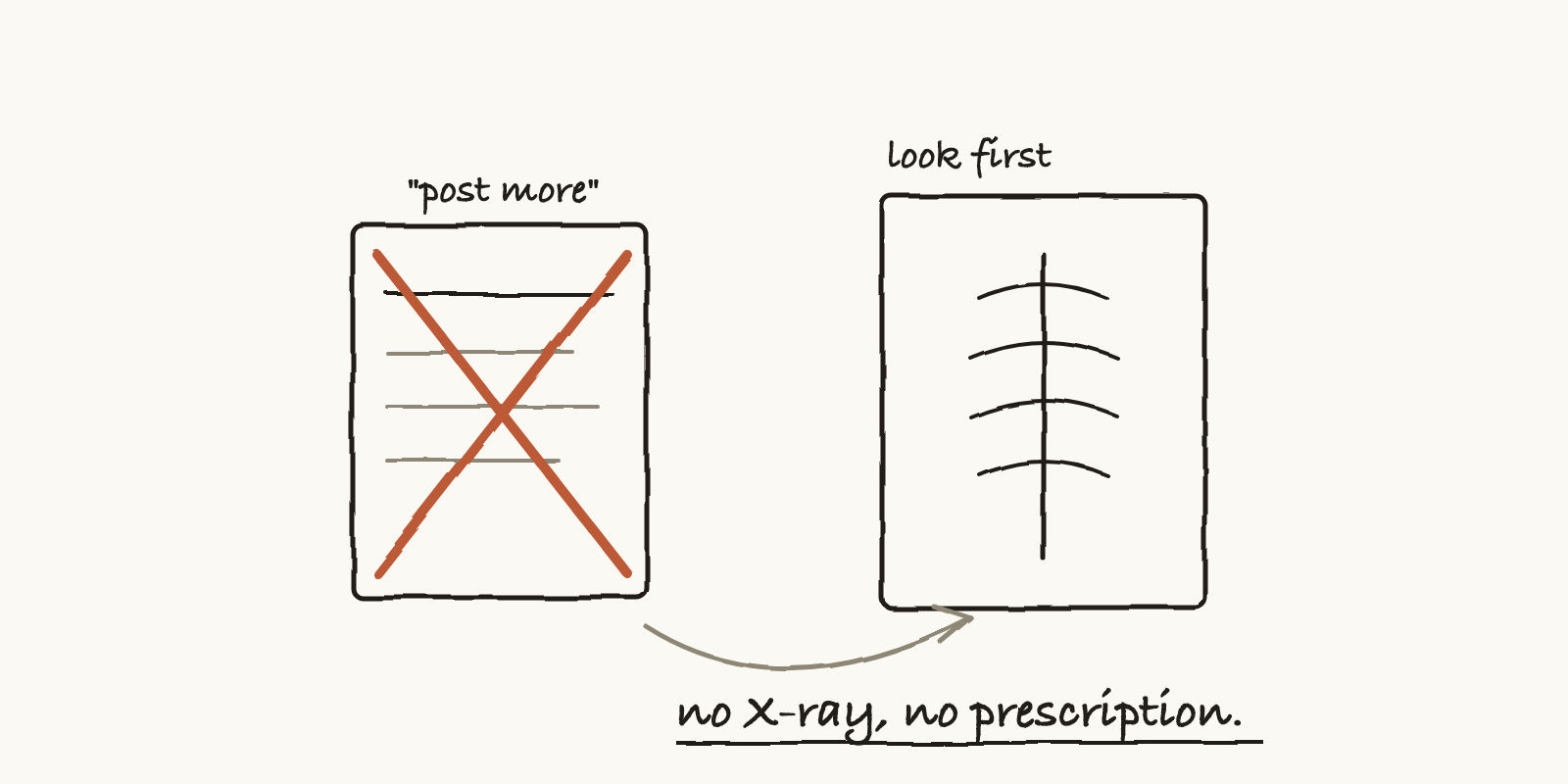
No stethoscope. No blood pressure cuff. No X-ray. He didn't even look up from his pad.
Would you take those pills?
Of course not. You'd be out the door before he finished writing. You might even report the guy.
But here's the uncomfortable part: this exact thing happens to business owners every single day, and most of us line up for it.
"Post more."
"You need to run ads."
"Start a podcast."
"It's your hooks. Fix your hooks."
Everyone has a prescription for your business. And not one of them has ever looked at your business.
Why everyone prescribes and nobody diagnoses
Now, we're not saying the people handing out this advice are bad people. Most of them genuinely believe in what they're selling, and plenty of it worked — for them, or for someone.
But the reality is, prescriptions are easy to sell and diagnosis is work. A tactic fits in a headline. "Do THIS to triple your sales." A diagnosis doesn't fit in a headline, because a diagnosis starts with questions about YOUR situation, and nobody can ask those questions from a stage.
So the advice industry runs almost entirely on prescriptions. And that leaves you — the business owner with the pain in your chest — collecting pills from a dozen different doctors, none of whom examined you.
I wrote something years ago, back when I was doing this work client by client, that I still stand by today:
Anyone who makes a diagnosis before establishing baselines is irresponsible, wildly incompetent, or preying on your hopes.
That sentence made a few people angry. I kept it anyway, because every year it keeps being true.
The same pill, two very different patients
Here's why this matters more than it seems.
Take the most common prescription of all: "post more content."
Business A has a page that converts. When the right person lands on it, they understand the offer, they see themselves in it, and a healthy number of them reach out. For Business A, "post more" is real medicine — every new visitor has a genuine chance of becoming a customer. More at the top means more at the bottom.
Business B has the same product, the same effort, the same work ethic — and a page that quietly loses almost everyone who touches it. The promise is vague, the next step is buried, and visitors leave without ever understanding what was on offer. For Business B, "post more" is poison. It burns months of effort pouring water into a bucket with a hole in it, and every empty month makes the owner more convinced that something is wrong with THEM.
Same pill. One patient gets better. One patient gets worse.
And without a diagnosis, you have no way of knowing which patient you are.
What a baseline actually is
When you finally get in front of a real doctor, notice what happens first. Before any talk of treatment — blood pressure, heart rate, temperature. Numbers. Boring, unglamorous numbers.
Those numbers aren't the interesting part of medicine. They're the part that makes the interesting part possible. Without them, the smartest doctor alive is just guessing.
Your business has a blood pressure too, and it takes about ten minutes to find:
-
How many people saw your page last month?
-
How many of them did anything at all — bought, booked, replied, joined your list?
That's it. Two numbers. Call them the two-number baseline — your business's pulse and blood pressure.
I know they look too simple to matter. But watch what they do to the conversation. "Nothing is working" — which feels true and is impossible to act on — becomes something like "about 400 people saw the page and 2 reached out." And that sentence has a shape. Maybe 400 is the problem. Maybe 2-out-of-400 is the problem. Those are different diseases, and they need different medicine.
The pain stops being mysterious the moment you measure it. (And when the baseline says 2-out-of-400 is the disease, the diagnosis almost always lands on one of the three loose wires.) And most owners have never measured it — not because they can't, but because nobody selling them tactics ever asked them to.
This week
Before you change anything — before the new posting schedule, before the ads, before the redesign — write down your two numbers. Last month's visitors. Last month's actions. They're sitting in your platform stats and your website analytics right now.
Don't fix anything yet. Just look.
That's the whole assignment. It's the least exciting advice you'll read this week, and it's the only advice in the pile that can't hurt you.
And if you want the full X-ray — what your page actually says, who it's speaking to, and where people are most likely leaking out — that's literally what we built the scan for. It reads your page first, and only then does it open its mouth.
It looks first. Then it talks. Which is all you ever wanted from a doctor anyway.
Written by Mboso