Nice Castle. Tide's Coming.
Why content businesses wash away at the first sale.
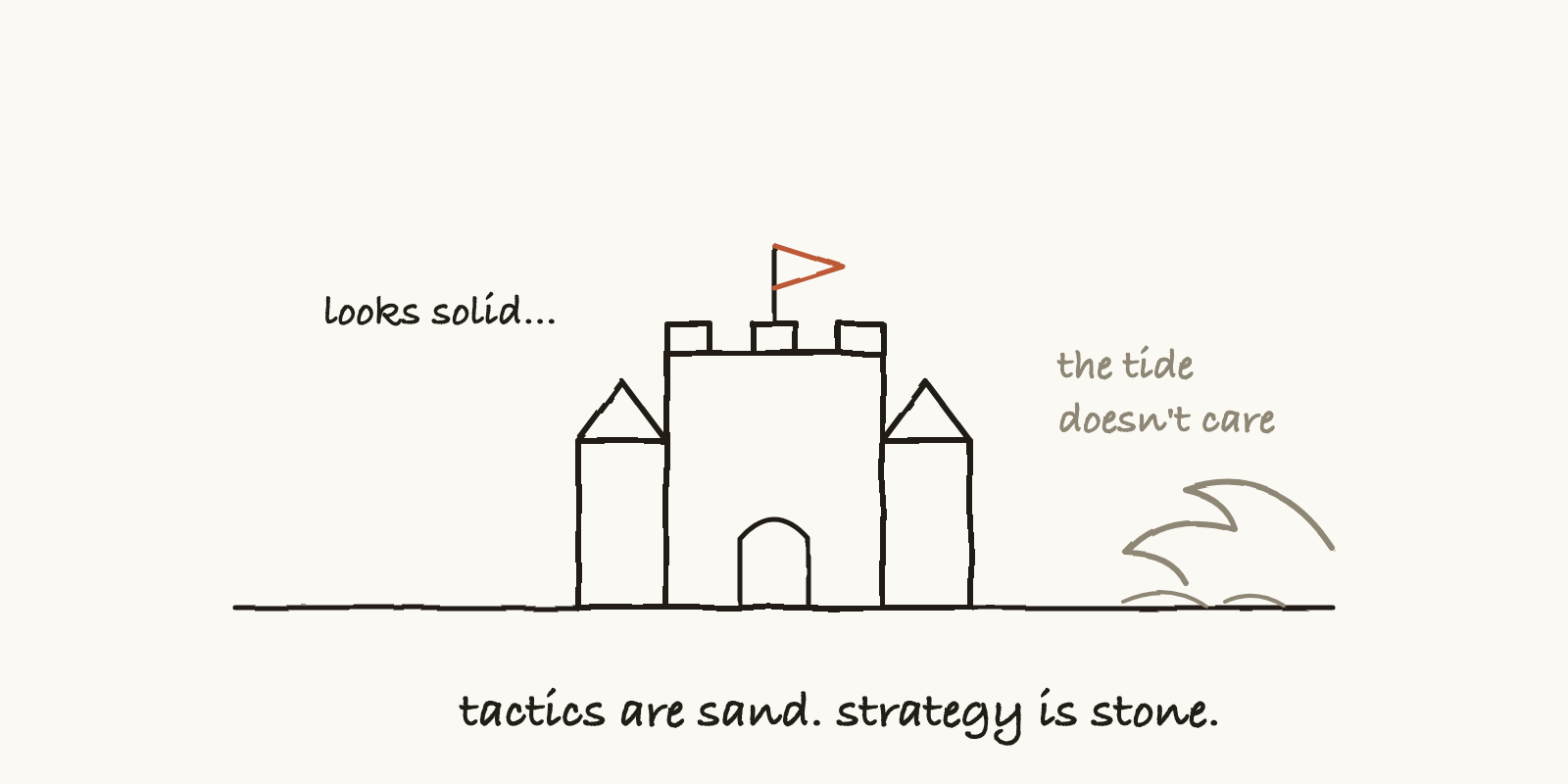
A sand castle looks exactly like a castle.
It has walls. It has towers. It has a gate, a moat, maybe even a little flag. From ten feet away, it's the real thing — you'd swear it could hold off an army.
And then the tide comes in.
Most content-based businesses are sand castles. Not because their owners are lazy — usually the opposite. Sand castles take real work. Hours of it, every day. The problem isn't the effort. The problem is the material.
I call them sand factors: things that give the ILLUSION of a business getting stronger, without ever producing sales. And after years of watching businesses get built and washed away — including a stretch of my own — I can tell you there are three big ones.
❌ Sand factor #1: The Magic Ingredient
"Maybe this next thing is what finally fixes everything."
The new camera. The new platform. The new editing style everyone's suddenly using. Each one arrives wearing the same promise: THIS is the missing piece.
So you buy it, or learn it, or install it. And for a week or two it genuinely feels like progress — there's a new skill in your hands, a new tool on your desk. Then the results come back the same, and somewhere out there, the next magic ingredient is already warming up.
Here's the pattern worth noticing: it's always the next thing. Somehow it's never the thing. If four magic ingredients in a row have failed to fix your sales, the reasonable conclusion isn't that ingredient five will be different. It's that you're not dealing with an ingredient problem.
❌ Sand factor #2: Toxic Visibility
You've heard the equation. More views = more followers = more sales.
It has the shape of logic. If you don't think about it too much, it almost sounds like math.
But the reality is that growing an audience and growing a base of potential buyers are FUNDAMENTALLY different activities. The tactics that make numbers go up — the trends, the stunts, the going-viral-at-any-cost plays — attract exactly the people those tactics deserve: spectators. People who came for the show.
And it's worse than neutral, because visibility has a price. Every stunt spends a little of the credibility you'd need to actually sell something. Do it long enough and you end up with the strangest business asset there is: a big audience in front of which you cannot mention your own product without the room going quiet.
You can't take likes to the bank. I've tried. The teller has questions.
We watched one founder live this exact equation to the end — views up, followers up, sales at zero. Her story has its own post.
❌ Sand factor #3: Dead-End Advice
Now — we're not saying the people teaching you these tactics are bad people. Most of them are good at exactly what they claim: growing accounts.
But the reality is, growing accounts is their full-time job. It's their product, their skill, and their proof. Ask them how YOU — a coach, a maker, a consultant with something real to sell — can turn attention into customers, and watch what happens. The advice gets vague, fast. "Keep showing up. Provide value. The sales will come."
They're not lying to you. They just can't teach you what they've never needed to do. Their business IS the audience. Yours isn't.
Taking sales advice from an account-grower is like asking a stadium architect how to win the game. Impressive building. Wrong expertise.
The octopus
So if tactics are sand, what's stone?
Think of your business like an octopus. The head is your strategy — who you serve, what you're selling them, and how a stranger becomes a customer. The tentacles are your tactics: gear, editing, trends, platforms, posting schedules.
With the head attached, an octopus is one of the smartest creatures in the ocean. Eight arms, all working on the same problem.
Without the head? Eight arms flailing, each with a mind of its own. A lot of motion. A lot of visible effort. Nothing coordinated, nothing accomplished.
Most struggling content businesses are headless octopuses. And here's the cruel part — from the outside, and even from the inside, a headless octopus looks BUSY. The flailing photographs well. It fills a content calendar. It just never grabs anything.
The tactics were never the problem. Tentacles are wonderful things when there's a head deciding what they're for. The same trending audio that wastes a headless business's week can genuinely serve a business that knows exactly who it's pulling in and where those people go next.
Sand isn't a material problem. It's a foundation problem.
This week
Here's the assignment, and it will feel strange: don't buy anything. Don't install anything. Don't learn one single new tactic.
Instead, take the one page you already have — your site, your profile, wherever people land when they want to know what you do — and ask it one question:
If 100 of the RIGHT people saw this today, would anything actually happen?
And know what the tide actually looks like before you answer. Nielsen Norman Group's research found most visitors abandon a page within 10–20 seconds unless the value is clear fast (NN/g). Across industries, the median landing page converts 6.6% of its visitors, and "good" — the top quarter — starts at 11.4% (Unbounce, 2024 Conversion Benchmark Report). So of your 100 right people, a stone page turns roughly 7 into action. A sand page rounds to zero.
Sit with that honestly. Would they understand what you're offering? Would they see themselves in it? Would they know what to do next — and is that next step one a stranger would plausibly take?
If the answer is no, then no tactic on earth can help you yet — every tentacle is flailing in service of a page that can't close. And if the answer is yes, congratulations: you're one of the few businesses for which "more visibility" is actually good advice — here's the arithmetic on what that visibility is worth.
Either way, you'd want to know which one you are. That's what the scan is for — it reads your page the way the tide reads a castle, and tells you what's sand and what's stone.
Better to find out before the water comes in.
Written by Mboso