Stop Writing.
Your customers already wrote your sales copy.
"What keeps people's attention long enough to hear what I have to offer?"
Hundreds of founders have asked us that question, almost word for word. It might be the most common question in online business.
And the honest answer is uncomfortable: nothing you say about yourself.
Not a better tagline. Not a sharper description of your method. Not the fourth rewrite of your About page. Attention doesn't come from describing yourself better, and the proof is sitting in your own behavior — think about the last time YOU stopped scrolling. Was it because a business described itself well? Or was it because something on the screen sounded like it was about you?
The thesaurus session
Here's what most of us do instead. I've done it too, so no judgment.
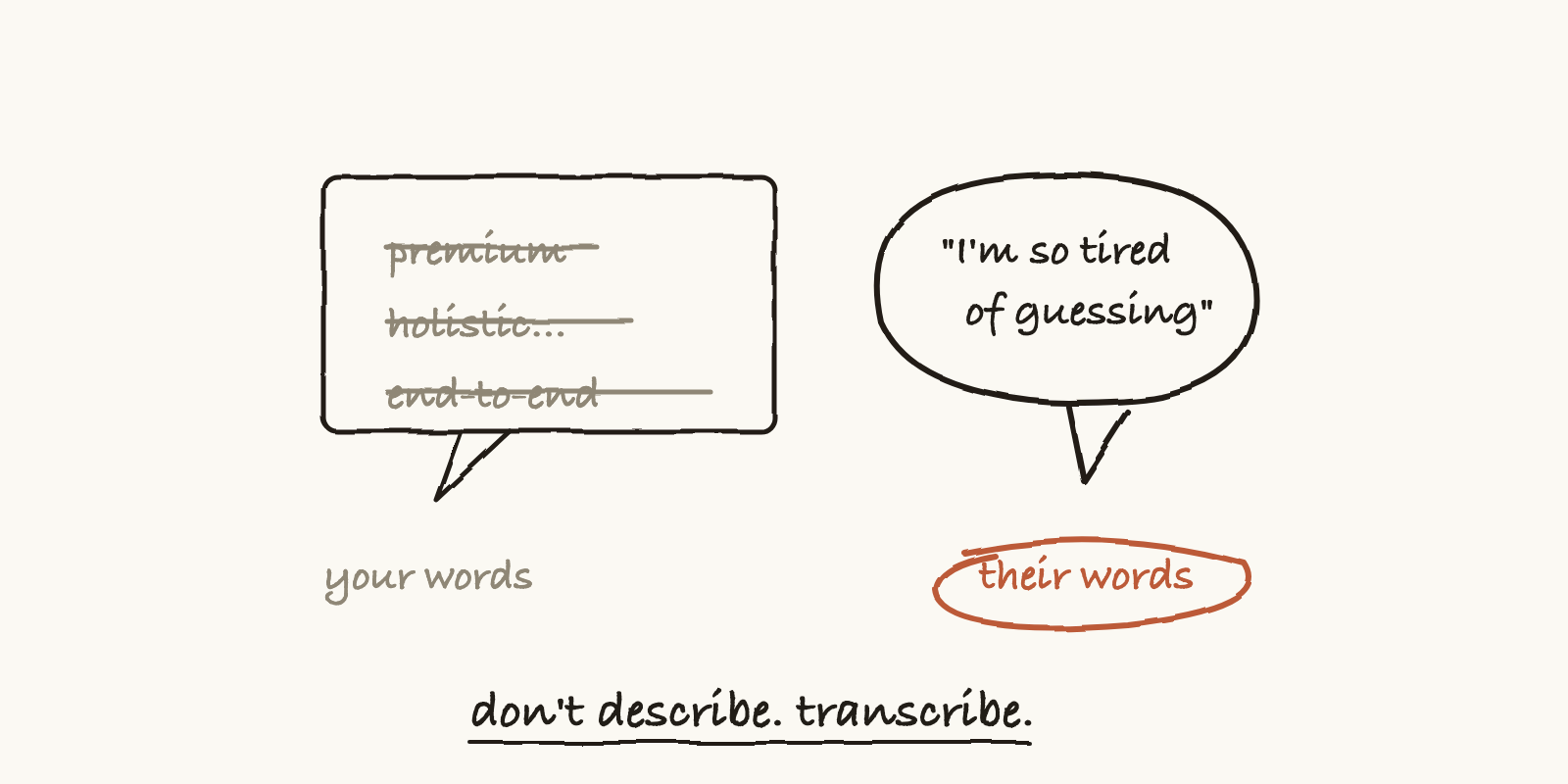
We sit down for another round with the thesaurus, polishing our own description of our own product. "Premium." "Holistic." "Transformative." "End-to-end." We swap words in and out like we're decorating a shop window, hunting for the combination that finally sounds impressive enough.
And the words we land on have one thing in common: no buyer has ever typed them.
Nobody has ever messaged a friend saying "I need something holistic." Nobody lies awake at night wishing for an end-to-end solution. Those are OUR words — the industry's words — and to the person scrolling past, they all melt into the same beige paste. Impressive-sounding. Instantly forgettable.
The thesaurus session feels like work. But it's effort spent making your words fancier, when the entire game is about making them THEIRS.
The conversation already happening
But the reality is, people don't buy the best product. They buy the one that sounds like the conversation already happening in their head.
Everyone you want to reach is already talking to themselves about their problem. Right now. In the shower, in the car, at 11pm complaining to a friend. And that inner conversation has exact wording — not "I need a holistic wellness program" but "I'm so tired of being tired all the time." Not "I need conversion optimization" but "people visit my site and then just… nothing."
When your page uses THEIR wording, something clicks that no amount of polish can produce. The reader feels caught — in a good way. "That's exactly it. That's what I've been saying." And in that moment you're no longer a stranger making claims. You're the one who understands — answering questions they didn't even know they had.
When you try to convince someone, it triggers an automatic defense. We can all smell a pitch coming. But recognition doesn't trigger the defense, because recognition doesn't feel like selling. It feels like being understood. That feeling is what actually holds attention — and attention held by recognition is the only kind that converts.
Transcription, not description
So the writing skill you're missing probably isn't description. It's TRANSCRIPTION.
Never assume — get the language directly from your audience. Not your best guess at their words. Not a persona document that says "Sarah, 34, values authenticity." Their actual sentences, with the grammar wrong and the frustration showing.
And here's the good news buried in all this: your best copy has already been written. It's sitting in places you already own.
-
The DMs where someone finally worked up the nerve to ask about your offer — look at the words they chose to describe their situation
-
The reviews and testimonials — not the compliments, the BEFORE parts: "I had tried everything…", "I was about to give up on…"
-
The emails that start with "I just want to…" or "I'm so tired of…"
-
The exact phrasing of questions people ask on calls, in comments, at the end of workshops
Watch the difference. You wrote: "A holistic coaching program for sustainable wellness." She said: "I want to stop feeling exhausted by 2pm every day." You wrote: "Done-for-you marketing systems." He said: "I just want people to actually reply."
One of these belongs on your page. It isn't yours.
And the gap isn't subtle. Matt Lerner, who ran growth at PayPal before coaching hundreds of startups, found that pages written in the founder's language typically convert around 0.5–3% — while the same offers rewritten in the customers' own words hit 8–40% (First Round Review). He calls it language/market fit. Same product, same traffic — different words, several times the sales.
And to be clear — this isn't a manipulation trick. You're not planting words in anyone's mouth; you're proving you listened. Mirror their words accurately and deliver honestly on them, and what you've built is trust at first sight. Mirror them without delivering, and you've built a very fast way to be found out. The words only work because the listening was real.
This week
Go collect 5 sentences that real buyers or prospects have actually said or written to you about their problem. (Your earliest customers — the Test Buyers — exist precisely to hand you these sentences.) Word for word — resist the urge to clean them up. The rough edges are where the recognition lives.
Then take the sharpest one and make it your headline.
Change nothing else. Not the design, not the offer, not the pricing — nothing. One change at a time is the only way you'll actually be able to read the result.
Then watch what happens when the next hundred visitors are greeted by their own thoughts instead of your industry's.
And if you're wondering whose words your page is wearing right now — yours or theirs — that's one of the first things the scan reads. It looks at your page the way a stranger does, and tells you what it heard.
Most founders are surprised by the answer. The page they polished for months turns out to be speaking a language their buyers never use. The fix isn't more polish.
It's their words. Not yours.
Written by Mboso