More Traffic Won't Save You
Traffic is linear; conversion is exponential.
"I need more traffic."
That's the most common self-diagnosis in online business. Sales are slow, so the answer must be more people. More posts, more reach, more eyeballs — MORE.
And I understand why it's the first place everyone's mind goes. Traffic is visible. Traffic is countable. Watching the visitor number climb feels like watching your business grow.
But the reality is, "more traffic" is almost always the most expensive item on the menu. Let's do the math together — slowly, with real numbers, because this is the part nobody slows down for.
The traffic path
Say 1,000 people visit your page in a month, and 1% of them buy. That's 10 sales. Simple enough.
Now let's say you take the traffic advice and — through real, sweaty effort — you DOUBLE your visitors. Two thousand people. Same page, same 1%.
20 sales. Congratulations.
But look at what you just signed up for. Doubling traffic isn't a thing you do once — it's a thing you do FOREVER. Double the posting, double the spend, double the grind, every single month, just to hold the new number. Miss a month and the visitors go back where they came from.
Traffic is a bill that never stops arriving. You don't own it. You rent it — from the algorithm, from the ad platform, from your own exhausted schedule. And the rent is not small: across industries, a single paid lead now averages about $67 (LocaliQ/WordStream search advertising benchmarks, 2025).
The hinge path
Now run it the other way. Same 1,000 visitors. No new content, no new ads, nobody new at all.
Instead, your page goes from converting 1% to converting 2%.
(And 2% is not a fantasy ceiling. The cross-industry median landing page converts 6.6% of visitors, and the top quarter starts at 11.4% — Unbounce, 2024 Conversion Benchmark Report. Most pages have far more hinge room than their owners suspect.)
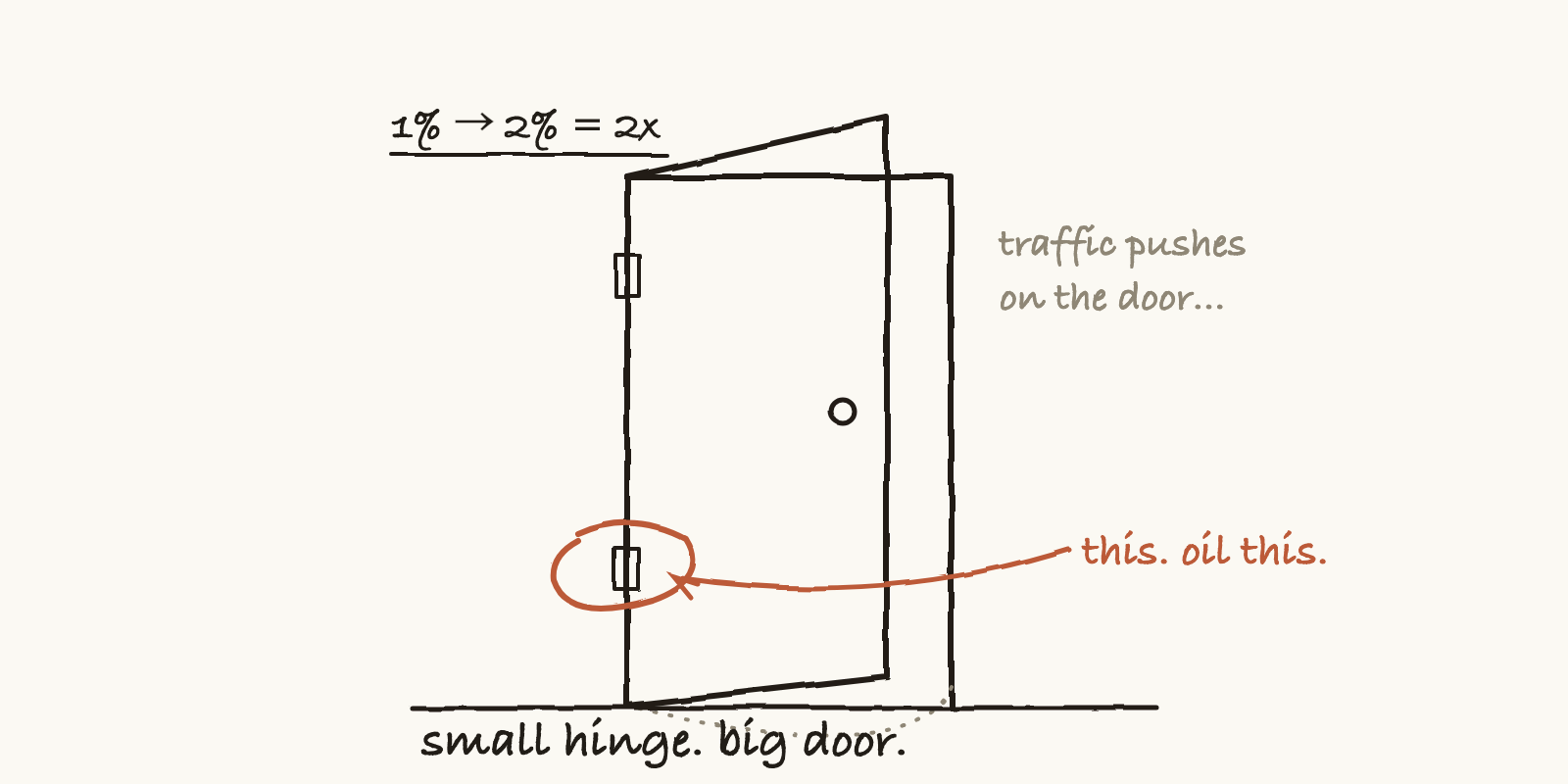
Same 1,000 people. 20 sales. The identical result of doubling your traffic — from moving one small number one point.
And where did that point come from? Not from more effort. From words on a page you already own. A promise made clearer. A first ask made smaller. One confusing paragraph, deleted. The kinds of changes that take an afternoon, not a lifestyle.
Here's the difference that matters most: the traffic you rent, but the fix you KEEP. A page that converts at 2% converts at 2% next month too, without you feeding it. You fixed it once; it pays you monthly.
Tiny hinges swing big doors — the old salesman W. Clement Stone's line, and here it's barely a metaphor. The door is heavy — all those visitors, all that potential revenue. The hinge is small — a headline, an ask, a promise. You don't move a heavy door by pushing harder on the door. You oil the hinge.
If you sell online, the biggest hinge usually sits at the end of the chain: 70.2% of shopping carts are abandoned before checkout completes (Baymard Institute). Seven in ten buyers who already decided to buy, lost at the last door.
Where it gets unfair: rates multiply
And it gets better, because your business isn't one rate. It's a chain of them.
Say your real chain looks like this: 1,000 people visit → 4% join your list (40 people) → 10% of those eventually buy (4 sales).
Now improve both rates modestly. Nothing heroic — 4% becomes 6%, 10% becomes 15%. Watch:
1,000 visits → 6% join (60 people) → 15% buy… 9 sales.
More than DOUBLE the result. Same 1,000 visitors. Two small hinges.
That's the part almost nobody sees: rate improvements don't add — they MULTIPLY. Each fix passes its gain to every step downstream. Meanwhile traffic only ever adds, linearly, at full price, forever.
Traffic is linear. Traffic × conversion is exponential. That one sentence is worth more than most courses.
One number that changes the question
So here's the number I want you to calculate this week. It takes two minutes.
Last month's revenue, divided by last month's visitors. (Start where every diagnosis starts — the two-number baseline — and add revenue.)
That's your Value Per Visitor — what each person who lands on your page is actually worth to you today.
Say it was $2,000 in revenue from 1,000 visitors: every visitor is worth $2. And that number quietly rewrites your whole strategy, because now "I need more traffic" has a price tag on it. More traffic means buying more $2 visitors — at whatever the platforms charge you in money or grind. But moving your conversion means making every visitor — the ones you ALREADY get, and every future one — worth $3, or $4.
The question changes from "how do I get more people?" to "how much is each person already worth, and where are they leaking?" The first question sentences you to the treadmill — running harder to earn the illusion of progress. The second one hands you a wrench.
To be fair: if 30 people saw your page last month, you may genuinely have a traffic problem — hinges can't multiply what isn't there. But that's exactly the point of calculating instead of guessing. The number TELLS you which problem you have. Most founders shouting "more traffic" have never once checked.
This week
Two minutes: revenue ÷ visitors. Write down your Value Per Visitor.
Then, before you spend one more hour chasing new people, ask what one hinge — one clearer promise, one smaller ask, one deleted confusion — might be worth across every visitor you already have.
The calculator behind the scan runs exactly this with your real numbers: your traffic, your rates, your dollars. It shows you what each hinge in your chain is worth per month — in actual money, not percentages — and which one to oil first.
Stop pushing on the door. Find the hinge.
Written by Mboso